GLPro Official Website › How It Works
How Does GLPro Work? The Daily Capsule Routine
GLPro is a once-daily capsule made to support blood sugar and appetite control.
The routine is simple: one capsule taken each day. This page explains what the support claim on the label means.
For the routine step by step, see how to take GLPro.
This page covers the seller’s own explainer, what blood sugar is in plain terms, what the research on category ingredients has found, what the GLPro label is allowed to claim, and how long buyers on this desk wait before judging it.
What the GLPro artwork says happens
Three panels, headed What Is Inside, What It Supports and Every Day.
The seller’s explainer runs in three steps. The first is headed What Is Inside and names nothing at all. The second lists what the capsule is said to support. The third is the routine, which is one capsule taken daily.
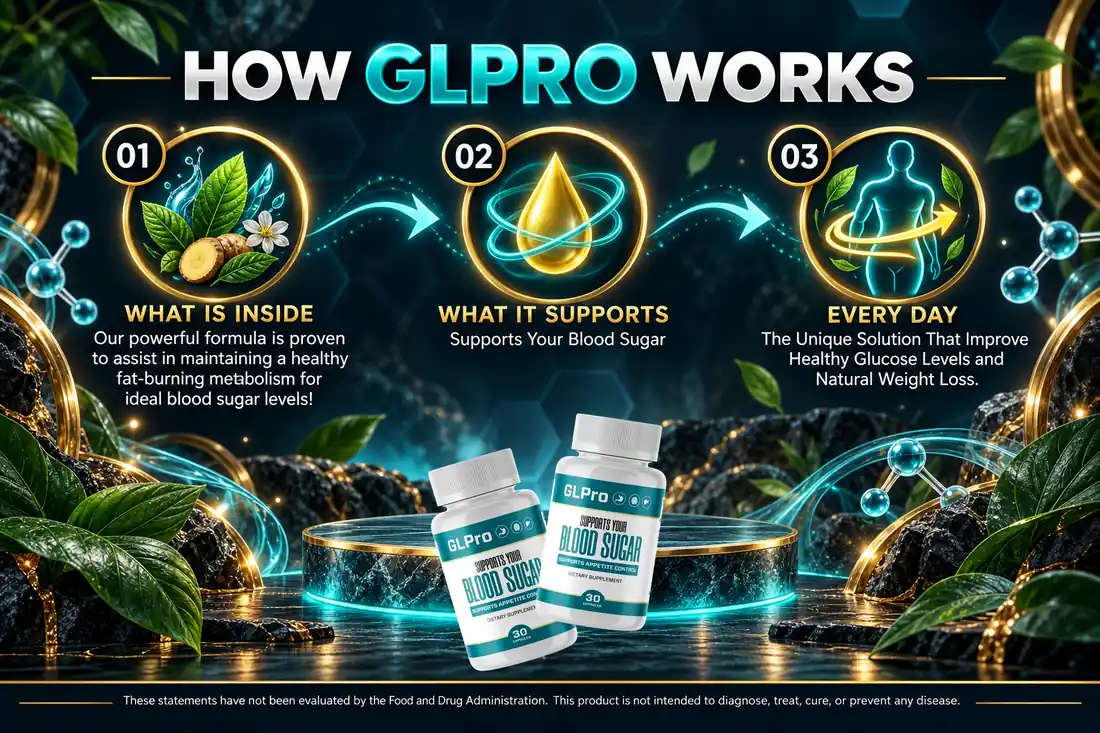
The same artwork carries the seller’s stronger wording, and this website quotes it rather than repeating it. “The #1 Blood Sugar Formula” is a superlative with nothing published behind it. “Our powerful formula is proven to assist in maintaining a healthy fat-burning metabolism for ideal blood sugar levels” uses the word proven, and a trial of the finished capsule is the thing that would have earned it.
So the honest answer to how it works arrives in two halves. The routine is real and checkable: one capsule a day, thirty to a bottle, taken for as long as you keep buying bottles. The mechanism is not traceable, because a mechanism belongs to a substance and no substance is named.
What a blood-sugar supplement like GLPro is generally meant to do
Start with the thing itself, in the words a government reference uses for it.
MedlinePlus describes blood glucose as “the main sugar found in your blood” and “your body’s primary source of energy”. It rises after a meal, that rise signals the pancreas to release insulin, and insulin “helps the glucose get into your cells”. For somebody with diabetes, the typical target before a meal is 80 to 130 mg/dL.
Products in this aisle are sold around that loop. The general story is support for keeping the rise after a meal inside a normal range, or support for how cells answer insulin. That is a description of the category rather than of GLPro, which names nothing that could be placed anywhere in it.
NIDDK’s guide to managing diabetes sets out what is actually managed, and no supplement appears in it: A1C, blood pressure, cholesterol and stopping smoking, with the A1C test showing “your average blood glucose level over the last 3 months” and a goal below 7% for most people with diabetes. Its instruction is to build the plan with a health care team. A capsule does not replace any part of that, and NCCIH says the same thing without softening it: “It’s very important not to replace medical treatment for diabetes with an unproven health product or practice.”
What the research on blood-sugar ingredients shows, and why it is not about GLPro
Four ingredients carry most of the research in this aisle, and none of them is on record as being in this bottle.
GLPro names no ingredient, so the studies below are not about GLPro. They are about chromium, cinnamon, gymnema and berberine, the four a blood-sugar capsule is usually built from, and they are here so a buyer can see what the category has actually been shown to do.
NCCIH’s summary is the fairest one-paragraph version of it. For a few supplements “there is weak evidence of a possible benefit”, some studies suggest chromium, cinnamon or berberine “might help with blood sugar control”, and the studies differ so much in size, formulation, dosing and length that they lead “to no clear conclusions”.
Cinnamon is the clearest lesson in why a name on its own is not information. Costello’s 2016 review of eleven randomised trials in 694 adults with type 2 diabetes found cinnamon doses running from 120 mg to 6,000 mg a day, a fiftyfold spread, with modest effects on fasting glucose and HbA1c and only four trials reaching the treatment goals the authors measured against.
The NIH fact sheet on chromium covers eight reviews and 58 trials in which daily chromium ran from 1.28 mcg to 1,000 mcg. Taken alongside treatment, chromium lowered fasting plasma glucose and HbA1c slightly in people with diabetes, and the sheet adds the qualification in the same breath: “the clinical significance of these findings is unclear.”
A placebo-controlled trial of Gymnema sylvestre gave 300 mg twice a day to thirty adults with impaired glucose tolerance, which is fifteen people an arm at a single centre. The largest berberine synthesis, fifty studies and 4,150 participants, reports the most common berberine dose as 0.9 to 1.5 g a day for one to three months, some of it taken alongside prescribed glucose-lowering drugs under trial supervision.
Read those four sentences again for the numbers rather than the names. Every one of them is a dose — and a dose is the thing a buyer holds against a panel. GLPro publishes no amount of anything, so there is nothing here to hold it against. That is the honest end of the comparison rather than a verdict in either direction.
Four ingredient names appear in this section. None of them appears on a GLPro label, in the seller’s material or in anything this desk holds, and none of them should be read as a guess at what the capsule contains.
What the GLPro label is allowed to claim
The verb on the front of the bottle is doing precise legal work.
The FDA’s page on structure and function claims says such a claim “may describe the role of a nutrient or dietary ingredient intended to affect the normal structure or function of the human body”. Claims of that kind “are not pre-approved by FDA, but the manufacturer must have substantiation that the claim is truthful and not misleading”.
Two words in that sentence matter here, and they are role and ingredient. A structure and function claim describes what a substance does, so it belongs to a substance. A bottle that supports blood sugar without naming what does the supporting has made a claim whose subject is missing, and no mechanism can be written for it without somebody inventing one.
The same page carries the reason the disclaimer exists at all. A label must also state that the product is not intended to “diagnose, treat, cure or prevent any disease”, “because only a drug can legally make such a claim”. That is the ceiling over everything this website says about GLPro, and it is a rule rather than a formality.
How long does GLPro take to work?
Buyers on this desk’s order book describe a wait rather than a first-week change.
Most people who wrote to this desk put that wait at 3 to 6 weeks. The eight reviewers held in detail wrote on days 30, 35, 38, 38, 47, 51, 56 and 60, and the two three-star lines both came from buyers who wanted a faster change and stopped at two bottles. The reviews page prints the roster and the three rating figures that do not reconcile with each other.
None of that is a prediction. It is a record of when people decided, which is a different and more useful thing: it tells you how long to leave before you judge, not what you will find when you do.
The arithmetic of the window follows from it. Two bottles are sixty capsules, which run out on the day the guarantee closes. Three are ninety, which is past the wait with a month still in hand. Six are the lowest price a bottle and 120 days of capsules bought after the window has shut. The price ladder has the three totals and the cost of a day.
What cannot be said about how GLPro works
Everything above, sorted into what holds and what does not.
What can be said
- One capsule a day, thirty to a bottle, is the routine the pack sizes fix.
- The bottle claims support for blood sugar and support for appetite control.
- A support claim is the strongest thing a supplement label may print.
- Buyers on this desk describe 3 to 6 weeks before they judge it.
What cannot
- Any mechanism, because no ingredient is named to carry one.
- Any dose comparison, because no amount is given for anything.
- Any result from a trial of the finished capsule; none has reached this desk.
- Anything about treating, preventing or managing diabetes or prediabetes.
Which is why the checkable parts of this purchase are the ones worth your attention. The routine, the printed claims and the sixty-day window can each be verified by somebody holding the bottle. A mechanism cannot, and no amount of confident writing changes that.
Who publishes this GLPro page?
Four claims about how this website is written, chosen because a sceptical reader can audit every one of them in ten minutes:
- The bottle is the source. The two claim lines, the capsule count and the supply length come from the printed label and the seller’s own artwork. Prices come from the seller’s order page, read on a stated date, not from a review column.
- The gaps are marked, never filled in. The seller names no ingredient and prints no amount, so this website names none and estimates none, including in the structured data a search engine reads.
- Sources are real and linked in the sentence. Every study cited here was confirmed against its PubMed record before it was written down, and every government page was opened and checked by its title rather than assumed.
- Corrections change the date. Write to [email protected] and the review date at the foot of the page moves forward.
We earn when you buy. Glproformula is the Licensed U.S. retail desk — GLPro named at the top of this page, and this website makes money on orders placed through it. That is exactly why the missing-formula pages, the three-star reviews and the plain statement that GLPro is not a GLP-1 medicine are here: they are where our interest and yours pull apart, and you should be able to watch us choose.
Order support on +1 (720) 738-6364 and [email protected] handles tracking, changes, cancellations and refunds. It is not a sales line, and this website never presents it as a way to place an order: orders go through the checkout only.
Sources for this GLPro mechanism page
- MedlinePlus, U.S. National Library of Medicine. Blood Glucose. https://medlineplus.gov/bloodsugar.html
- National Institute of Diabetes and Digestive and Kidney Diseases. Managing Diabetes. https://www.niddk.nih.gov/health-information/diabetes/overview/managing-diabetes
- National Center for Complementary and Integrative Health. Diabetes and Dietary Supplements: What You Need To Know. https://www.nccih.nih.gov/health/diabetes-and-dietary-supplements-what-you-need-to-know
- U.S. Food and Drug Administration. Structure/Function Claims. https://www.fda.gov/food/nutrition-food-labeling-and-critical-foods/structurefunction-claims
- Costello RB, Dwyer JT, Saldanha L, Bailey RL, Merkel J, Wambogo E. Do Cinnamon Supplements Have a Role in Glycemic Control in Type 2 Diabetes? A Narrative Review. J Acad Nutr Diet. 2016;116(11):1794-1802. https://pubmed.ncbi.nlm.nih.gov/27618575/
- NIH Office of Dietary Supplements. Chromium: Fact Sheet for Health Professionals. https://ods.od.nih.gov/factsheets/Chromium-HealthProfessional/
- Gaytan Martinez LA, Sanchez-Ruiz LA, Zuniga LY, Gonzalez-Ortiz M, Martinez-Abundis E. Effect of Gymnema sylvestre Administration on Glycemic Control, Insulin Secretion, and Insulin Sensitivity in Patients with Impaired Glucose Tolerance. J Med Food. 2021;24(1):28-32. https://pubmed.ncbi.nlm.nih.gov/32460589/
- Wang J, Bi C, Xi H, Wei F. Effects of administering berberine alone or in combination on type 2 diabetes mellitus: a systematic review and meta-analysis. Front Pharmacol. 2024;15:1455534. https://pubmed.ncbi.nlm.nih.gov/39640489/
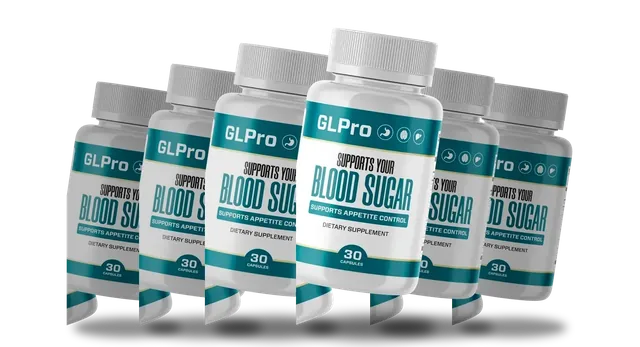
Get GLPro from the official website
Three bottles is the order this desk suggests first, and every order carries 60 days to change your mind.
$49 to $79 a bottle · 60 days to change your mind
Order GLPro On The Official WebsitePaid once at the checkout · 60-day money-back guarantee · lot GLP-26/GL-5442